THE ARTISTS' BRUSH: WORLD HISTORY, THEORY & PRACTICE
  • Home
  • Outline
  • Forewords
  • Author
  • Corrigenda
  • Home
  • Outline
  • Forewords
  • Author
  • Corrigenda
Search by typing & pressing enter

YOUR CART

​Outline

Picture
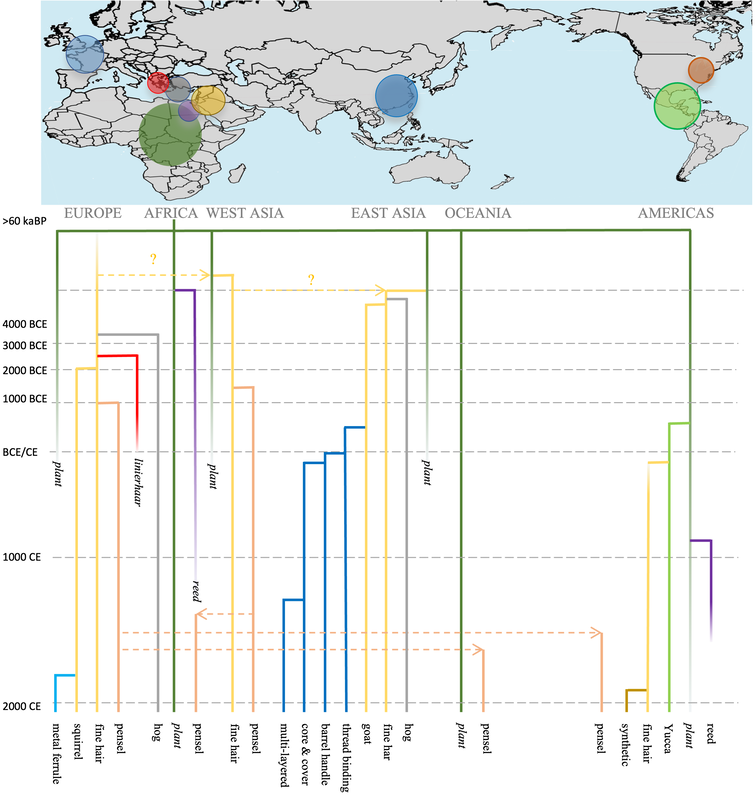
Chapter 1, Figure 1  Schematic dendrogram illustrating the main developments of the artists’ brush during its evolution over time and geography (‘pensel’ brush refers to a quill mounted tuft of fine hair such as squirrel or weasel) – dashed lines indicate inter-cultural influence
​Homo sapiens are defined by wisdom, symbolic thought and tool making: these attributes are a prerequisite for, and embodied in, the development and use of the artists’ brush. Indeed, the brush is emblematic of H. sapiens’ ability to create representational art, write and to communicate. 
 
This unique book, for the first time, examines the evolution and importance of the artists’ brush over time and geography. Extensively researched and referenced, it details the development and use of the brush from deep history to modern day, placing the brush in the context of the cultures in which it was used. Richly illustrated it describes works on rock, walls (murals and frescoes), ceramics, textiles, panels (stone, wood), codices, calligraphic manuscripts and other peinture d'objets [painted objects].
 
The history of art is re-told placing the brush at its centre - a tool, which in the hand of an artist, is responsible for some of the greatest and defining insignia of mankind. This book sheds light on historic artistic practices in Africa, Asia, Oceania and the Americas that are frequently overlooked and under reported in academic literature. Bayliss Brown’s scholarship is commendable and the chapters on brush anatomy, physics and mark making are essential reading for any artist or historian.
 
This book is a masterpiece and deserves to be in every school, university and bookcase of any serious artist - it is surprising that it has never been written before. 

© copyright Bayliss Brown 2024